Home / Services / Mobile TIG Welding
On-site welding
Some parts are bolted down, plumbed in or too big to haul. We bring the TIG machine, argon, purge gear and tools to the job, weld it in place and clean up before we leave. Travel anywhere in Texas is quoted by distance.
Plant shutdowns
Repairs in place
Statewide travel
Purge on site
Short answer
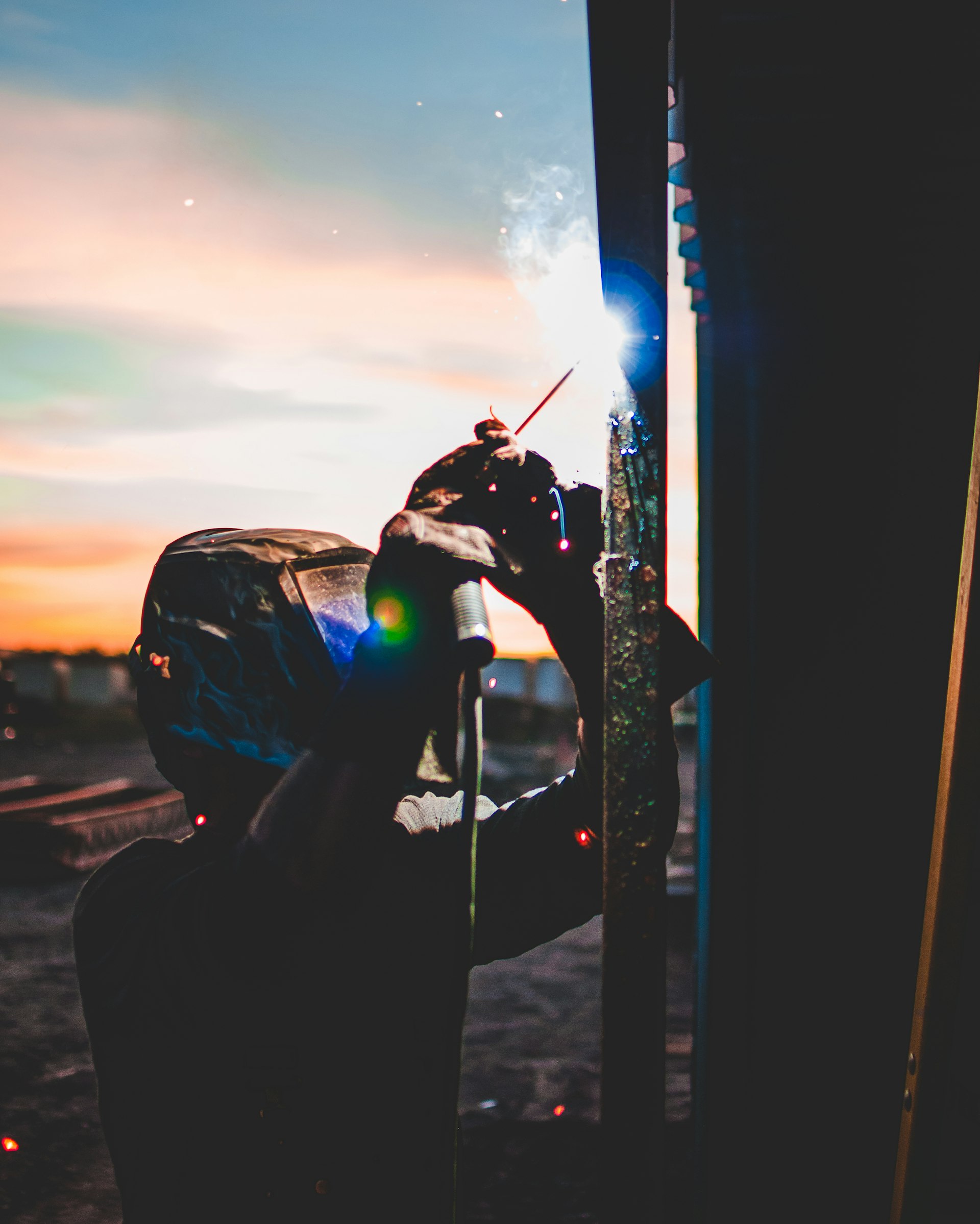
Mobile TIG welding means the welder comes to your site with a portable or truck-mounted TIG setup instead of you bringing the part to a shop. It is used for installed tanks, process piping, railings, food equipment and machinery that can't be removed. The work is the same as shop TIG, but wind, access, power and plant safety rules all have to be planned for.
At a glance
Processes on site
DC TIG for steel and stainless; AC TIG for aluminum where power allows
Power
Engine-drive welder, or plant power when it is available and approved
Materials
Carbon steel, 304 / 316L stainless, 5xxx and 6xxx aluminum, chrome-moly
Travel
Anywhere in Texas, quoted by distance from the job
Typical codes
AWS D1.1, AWS D1.6, ASME B31.3, as your site specifies
If the part can come off and ride in a truck, shop welding is usually cheaper and cleaner. Mobile work earns its keep when removal would cost more than the weld: a jacketed kettle plumbed into a line, a stainless handrail anchored in concrete, a cracked pump base under a running motor, a pipe tie-in on a unit coming back from a turnaround.
It also makes sense when downtime is the expensive part. A plant losing production by the hour doesn't want a two-day round trip to a shop for a thirty-minute weld. Our post on mobile welding vs shop fabrication walks through how to decide.
An engine-drive welder with TIG capability handles DC work on steel and stainless anywhere there is no power. For aluminum, which needs AC, we bring an inverter that can run on generator or plant power. Argon cylinders, a flowmeter for the torch and another for the purge, purge plugs and dam material, an oxygen analyzer for stainless roots, and a stack of grinders with discs marked for each metal.
Then the things that make field welds come out like shop welds: welding blankets, a pop-up windscreen and tarps, clamps and chain to hold fit-up, and a torch with a gas lens and a large cup, because a light breeze is enough to strip argon off the puddle. Shielding gas starts to lose the fight above about 5 mph of wind. If we can't block it, we stop and wait rather than welding porous metal.
Most engine drives start the TIG arc by lift-arc rather than high frequency, which is actually an advantage around plant electronics and PLC cabinets that don't like HF noise. The tradeoff is a slightly less forgiving start, so tungsten prep matters: a fresh point ground lengthwise, a few spares in the box, and no touching the puddle.
Plant work is planned around your outage window. We walk the job ahead of time when possible, confirm the material and the procedure, and stage gas and fittings so welding starts as soon as the line is cleared. On a stainless tie-in, purge dams go in while the fitter is still cutting.
We work under your site's safety program: hot work permits, gas testing, fire watch, lockout/tagout and confined space entry where it applies. If your site needs a specific safety orientation, badge or credential like a TWIC card, tell us when you request the quote so it is sorted out before the work date, not at the gate.
Along the Houston Ship Channel and in the plants around Houston, a lot of this is process pipe and equipment repair during planned outages. Food plants mostly want short-notice repairs on sanitary equipment between production runs.
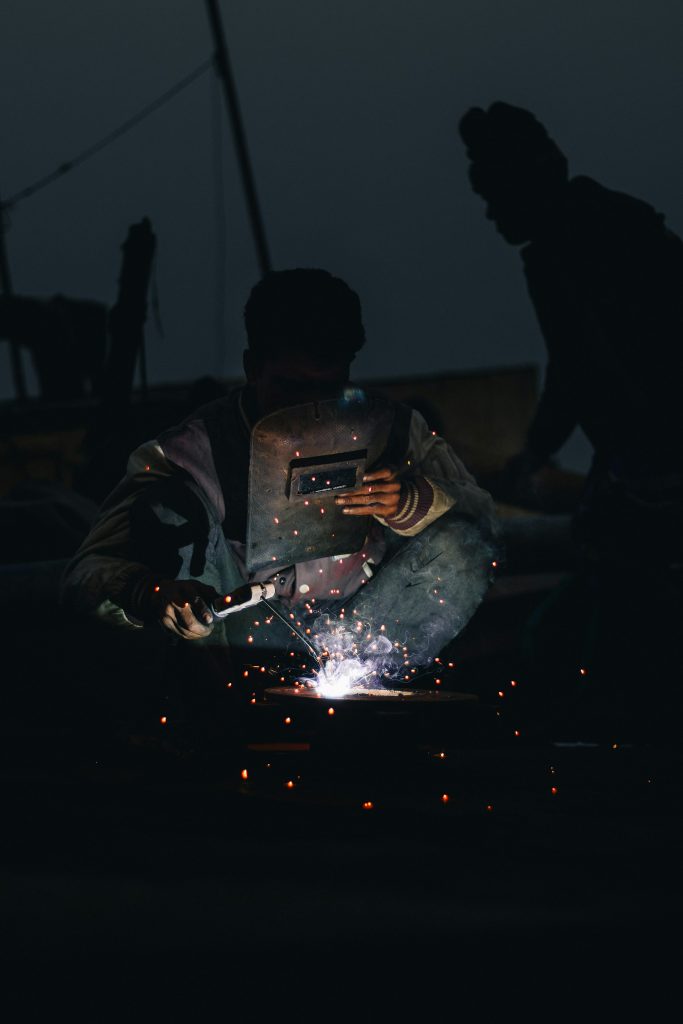
Welder crouched over a field weld at night with sparks at the joint
Most mobile calls are repairs. Stainless tanks with cracked nozzles or legs, broken brackets on conveyors and hoppers, worn chute liners, damaged handrail, aluminum boat T-tops and ladders, trailer frames, gates and dock equipment.
The routine is the same as in the shop, just in a harder spot. Clean to bright metal with tools that haven't touched carbon steel if the part is stainless. Grind cracks out until a dye penetrant check comes back clean. Purge whatever needs it. Then weld, blend and clean up heat tint, so a food contact surface goes back into service with a smooth, cleanable finish. Our weld repair and restoration page covers how we decide whether a cracked part is worth fixing.
A field weld doesn't get a pass because it was done on a ladder. It gets the same visual inspection, the same dye penetrant check on critical fillets and the same radiography or hydro test the job would get in the shop. When your spec calls for a qualified procedure and welder records under AWS D1.1, AWS D1.6 or ASME Section IX, let us know early so the paperwork is part of the plan.
Position is the real difference. Overhead and vertical welds are slower and need a smaller puddle. We tell you up front when a joint's access will slow things down, so the schedule isn't a surprise.
Preheat and distortion control come along too. A thick carbon steel base in a cold January morning gets a rosebud torch and a temp stick before the first pass. Thin stainless panels on a cabinet get short stitches and a cooling wait between them, even if it means standing around for a few minutes. Field welders who skip that step are the reason so many site repairs look wavy.
Have a drawing or a photo of the part?
Text it to us or send it through the quote form. We reply with questions or a written quote.
We travel statewide: the Gulf Coast refineries, Dallas and Fort Worth manufacturing, Central Texas breweries and fabs, San Antonio food plants, and the coastal bend. Travel is quoted by distance from the job, plus the expected hours on site. Multi-day jobs may add lodging, listed in the quote. For a sense of how welding labor is usually priced in the market, see our post on TIG welding cost in Texas.
Remote work is fine. Ranch tanks, pivot irrigation frames and oilfield equipment out past cell coverage just need a clear pin on the map and a call about road conditions, since a loaded welding truck and a muddy lease road don't get along. Multi-day jobs are often cheaper per hour on site than several separate trips, so if you have a punch list, send the whole thing at once.
Site jobs depend on details that never show up in a drawing. The more of these you can answer, the fewer surprises on the day. Call (346) 561-0862 or send it in writing.
City and site type: plant, jobsite, marina, ranch, residence
Photos of the joint and the space around it
Metal and thickness, if known
Power available and whether hot work is allowed
Safety, badge or permit requirements at the gate
Your work window: shutdown dates, nights or weekends
Can you TIG weld outside in the wind?
Yes, but only with protection. TIG relies on a gentle stream of argon, and wind above about 5 mph can blow it away and cause porosity. We use windscreens, tarps, welding blankets, gas lenses and larger cups to keep the shield in place. If the joint still can't be sheltered, we wait for calmer conditions. A porous weld is worse than no weld.
Do mobile welders charge for travel?
Most do, and the way it is charged varies. Some bill a flat trip fee, some charge by mileage, and some bill travel time at an hourly rate. For jobs across Texas we quote travel by the distance to your site, along with the expected time on site. Multi-day trips may add lodging, listed in the quote. Ask any welder to show travel separately so you can compare quotes.
Can you weld aluminum on site?
Yes, with an AC TIG inverter running on generator or plant power. Aluminum is pickier in the field than steel, because it needs very clean metal, steady argon coverage and protection from wind. Boat T-tops, ladders, trailer frames, dock gates and aluminum tanks are common on-site jobs. Badly corroded or oil-soaked parts often come out better in the shop.
Can you weld stainless food equipment without removing it?
In many cases, yes. We clean the area with stainless-only tools, purge the back side if it is accessible, weld, then remove heat tint and blend the surface so it stays cleanable. Whether a weld can be done in place depends on access to the back side and how much product contact area is involved. Equipment must be shut down, cleaned and locked out first.
Do you work during plant shutdowns and turnarounds?
Yes. Shutdown work is scheduled ahead with the plant, and the job is planned around the outage window, the procedure and the site safety rules. Give us the dates, the scope and any required inspection early. Pre-job walk-downs help us stage material and purge equipment so welding can start as soon as the area is released.
What do I need to have ready for a mobile welder?
Clear access to the joint, the equipment shut down and locked out if it is machinery, and any hot work permit your site requires. Tell us about the power available and whether a generator can run nearby. Move flammables away from the area or tell us what is there. If the part is painted, coated or oily, say so, since it changes prep time.
Weld repair
Cracked aluminum and stainless parts, cast aluminum, cast iron and failed welds, repaired after we find out why they broke.
See the service →
Pipe & tube
TIG root passes on process pipe, sanitary tube and chromoly, with purge, fit-up and inspection planned around B31.3, B31.1, 3-A or BPE.
See the service →
Stainless steel
304 and 316L stainless TIG welded with full back purge, controlled heat tint and clean, passivated finishes for food, pharma and architecture.
See the service →
Get a quote
Send drawings, photos or a short description. We reply with questions or a written quote.
Request a quote