Home / Services / Pipe & Tube TIG Welding
Process and sanitary
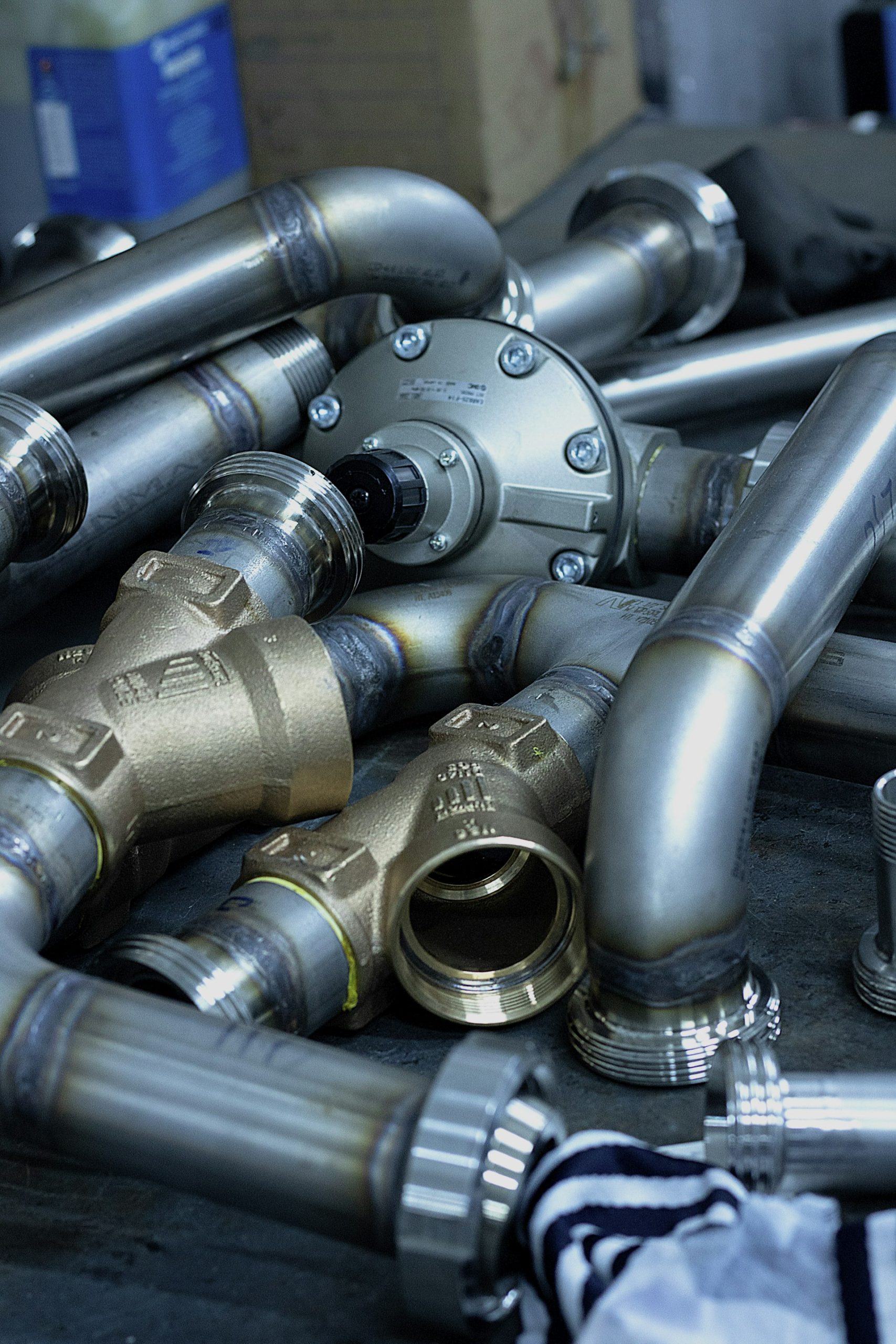
We TIG weld carbon, stainless and chrome-moly pipe and thin-wall sanitary tube. The root pass is where pipe welds pass or fail, so that is where most of our attention goes: bevel, land, gap, purge and a full-penetration root you could look at with a borescope.
Open-root TIG
Purged roots
B31.3 and B31.1
Sanitary tube
Short answer
TIG pipe welding is used for root passes and complete welds on process piping, steam lines, sanitary tube and alloy pipe, where full penetration and a clean inside surface matter. The welder controls a small puddle with a tungsten arc and hand-fed filler, often with argon purging the inside. Many shops run a TIG root and hot pass, then fill and cap with TIG or stick per the WPS.
At a glance
Materials
Carbon steel A106 / A53, 304L and 316L stainless, P11 and P22 chrome-moly
Filler metals
ER70S-2, ER70S-6, ER308L, ER316L, ER80S-B2, ER90S-B3
Joint prep
37.5° bevel, about 1/16 in. land, 3/32 to 1/8 in. root gap
Sizes
Sanitary tube from 1/2 in. OD; pipe from 1/2 in. NPS up
Typical codes
ASME B31.3, ASME B31.1, ASME Section IX, 3-A, ASME BPE
Caps get the compliments. Roots carry the line. A pipe weld with a pretty cap and a root that sucks back, sags or never fused will leak, erode or crack long before the outside shows anything. On stainless and chrome-moly, the root also has to be shielded from air or it oxidizes into a rough crust.
TIG is the process most pipe welders trust for that first pass. It puts down a controlled keyhole, lets the welder add filler exactly where the gap opens up, and leaves a smooth, slightly convex bead on the inside. On carbon steel we often follow with a TIG hot pass and then fill and cap with TIG or stick electrodes like E7018, whichever the procedure allows. On thin-wall stainless and sanitary tube, the whole weld is TIG.
The defects we hunt for on a root are the same ones a radiographer will find: incomplete penetration, lack of fusion at the tacks, concavity at the 6 o'clock position where gravity pulls the puddle, and tungsten inclusions from a dipped electrode. Most of them start with fit-up, which is why the next section matters more than any welding technique.
Most open-root butt welds start with a 37.5° bevel and a land around 1/16 in. thick. We set a root gap close to the filler diameter, 3/32 or 1/8 in., and tack on four quarters, feathering each tack so the root ties into it cleanly. Hi-lo, the step between two pieces that don't match, is checked with a gauge. Too much and the root can't fuse both sides.
Socket welds are a different joint: a fillet around a fitting, with a 1/16 in. gap left at the bottom of the socket so the pipe can grow without cracking the weld. Small-bore lines in plants are full of them, and skipping that gap is one of the most common causes of socket weld failure.
Stainless pipe gets an argon purge on the inside. We dam both sides of the joint with purge plugs, foam or dissolvable paper, flow argon until the oxygen meter is low, then tape over the gap and weld while venting. Big diameters take a long time to purge, so dams placed close to the joint save gas and hours. Carbon steel roots don't need a purge.
Chrome-moly is where procedures get strict. P11 (1-1/4Cr-1/2Mo) takes ER80S-B2 filler and P22 (2-1/4Cr-1Mo) takes ER90S-B3, with preheat often around 300 to 400°F held through welding and post-weld heat treatment where the code requires it. Low-hydrogen practice is not optional. Race-car 4130 chromoly tube is a separate thing: thin wall, usually ER70S-2 or ER80S-D2 filler, and no PWHT in most cases.
Carbon steel A106 / A53: ER70S-2 or ER70S-6 root, no purge
304L / 316L: ER308L or ER316L, full argon purge
Stainless to carbon: ER309L with purge on the stainless side
P11 / P22 chrome-moly: matching B2 or B3 filler, preheat, PWHT per code
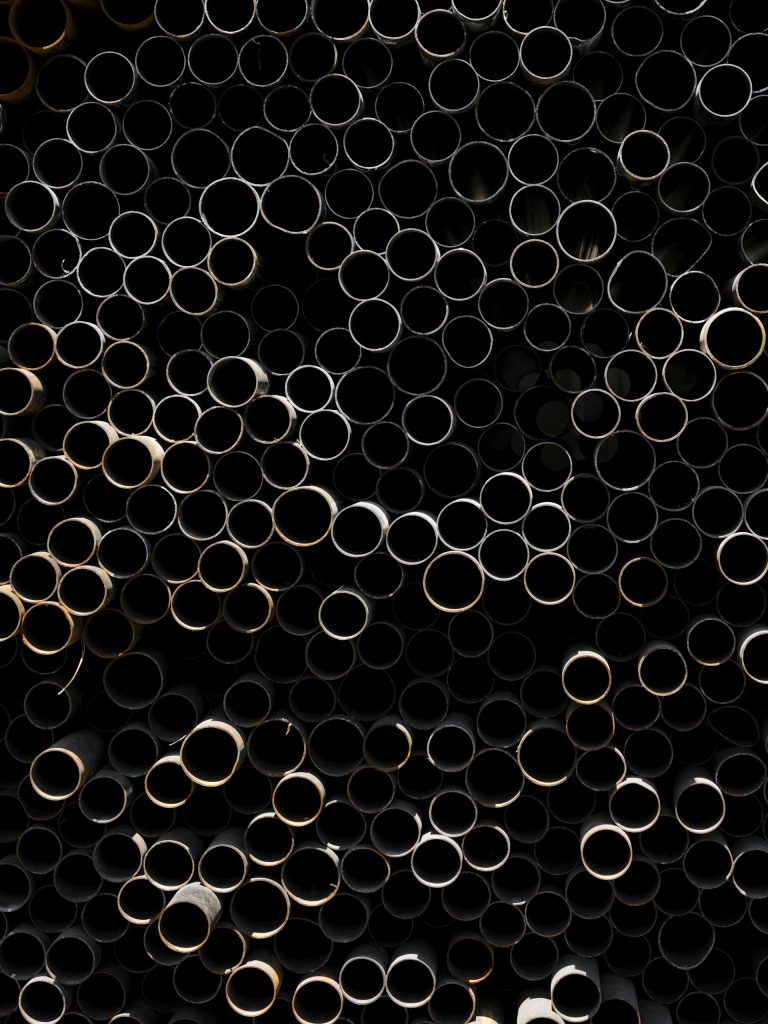
Ends of stacked steel pipe and tube in a storage rack
Dairy, beverage, pharma and semiconductor lines run thin-wall tube, usually 0.065 in. wall 316L, and the inside of every joint is a product contact surface. Ends are cut square and faced, fitted with no gap and fused, often without filler. A crevice, a concave root or heavy discoloration on the ID is a place for bacteria or particles to collect.
That work answers to 3-A sanitary standards or ASME BPE, which set limits on root convexity, misalignment and heat tint color. Orbital welding is common for long BPE runs; manual TIG still handles fittings, short spools and repairs. We borescope roots and keep a weld log when the job calls for it. Our post on sanitary tube welding standards explains what inspectors look for, and the base-metal side of it is on our stainless steel TIG welding page.
ASME B31.3 covers process piping in refineries, chemical plants and many food and pharma plants. B31.1 covers power and steam piping. Both require welding procedures and welders qualified under ASME Section IX. If your job needs a WPS, PQR and welder qualification records, tell us at the start so they are part of the plan and the quote.
Inspection follows the code and the fluid service. Visual on everything. Dye penetrant on socket welds and stainless fillet welds. For B31.3 normal fluid service, the base rule is random radiography of at least 5% of butt welds; severe cyclic or high-pressure service asks for more. Hydrostatic or pneumatic testing usually closes out the system.
Have a drawing or a photo of the part?
Text it to us or send it through the quote form. We reply with questions or a written quote.
Spool pieces, manifolds, skid piping and short runs are faster and cleaner to build in a shop, where we can roll the pipe and weld in the flat position. Tie-ins, replacements and repairs on a running unit happen on site, often during a shutdown. Our mobile TIG welding service handles field joints, with the same purge and fit-up standards in a tighter space.
Field pipe is mostly a positioning problem. A 6G joint under a pipe rack, a tie-in six inches off a wall or a line that can't be fully drained all change how long the weld takes and how the purge is set up. Walk-downs before the shutdown catch most of that. We would rather look at the access ahead of time than find out on the first morning of the outage.
Isometrics or a marked-up P&ID are ideal. A line list works. For a repair, photos of the joint and the tag on the line help a lot. Send what you have through the contact page or call (346) 561-0862.
Material spec and grade (A106-B, 316L, P11)
Size and schedule, or tube OD and wall
Number of butt welds and socket welds
Governing code and fluid service
Inspection required: RT percentage, PT, borescope, hydro
Shop fabrication, field installation or both
Do you need to purge carbon steel pipe when TIG welding?
No. Carbon steel roots are normally welded without a back purge. The inside of the root oxidizes a little, but carbon steel doesn't lose corrosion resistance the way stainless does. Purging is needed on stainless, nickel alloys, titanium and often chrome-moly over a certain chromium content, depending on the procedure. Some specs still ask for it, so check the WPS.
What is the difference between ASME B31.1 and B31.3?
B31.1 is the power piping code, for steam, boiler feed and power plant systems. B31.3 is the process piping code, for refineries, chemical plants, pharmaceutical and food plants and terminals. Both rely on ASME Section IX for welding qualification, but they differ in design rules, examination percentages, heat treatment requirements and testing. The plant owner decides which code a system falls under.
What filler metal do you use for TIG welding 316L pipe?
ER316L for 316L to 316L, under an argon shield and a full argon back purge. For 316L joined to carbon steel, ER309L is standard because it handles the dilution from the carbon side. On autogenous sanitary tube welds, no filler is added and the tube itself forms the weld, which is why fit-up and squareness have to be nearly perfect.
How much X-ray does B31.3 require on pipe welds?
For normal fluid service, B31.3 calls for random examination of at least 5% of circumferential butt welds, by radiography or ultrasonic testing. Category M, high-pressure and severe cyclic service require more, up to 100%. The owner or engineer can always specify more than the code minimum. Tell us the examination level up front, because it affects how the job is planned.
Can you TIG weld chromoly pipe?
Yes. Chrome-moly pipe like P11 and P22 is commonly TIG rooted with matching ER80S-B2 or ER90S-B3 filler. It needs preheat held through welding, careful hydrogen control and often post-weld heat treatment, all set by the code and the procedure. Thin 4130 chromoly tube for race cars and roll cages is a simpler job and usually needs no PWHT.
What is the 1/16 inch gap on a socket weld for?
That gap lets the pipe expand into the socket when it heats up. If the pipe is bottomed out in the fitting, thermal growth and vibration load the fillet weld, and it cracks at the root. Codes like B31.1 and B31.3 call for the gap, usually around 1/16 in. before welding. A simple gap ring or a marked pull-back sets it.
Stainless steel
304 and 316L stainless TIG welded with full back purge, controlled heat tint and clean, passivated finishes for food, pharma and architecture.
See the service →
Mobile welding
On-site TIG welding for plant shutdowns, installed equipment and repairs that can't come to the shop. Statewide travel, quoted by distance.
See the service →
Custom fabrication
One-offs and short runs cut, formed, fitted and TIG welded: brackets, frames, enclosures, tanks, rails and prototypes.
See the service →
Get a quote
Send drawings, photos or a short description. We reply with questions or a written quote.
Request a quote