Home / Services / Weld Repair & Restoration
Cracks and failed welds
We repair cracked aluminum and stainless parts, cast aluminum housings, cast iron where welding or brazing suits it, and welds that failed in service. Every repair starts with the same question: why did it crack? Fix that, and the repair lasts.
Cracked castings
Cast iron brazing
Failed welds
Root-cause first
Short answer
Most cracked metal parts can be repaired if the crack is ground out completely, the cause is understood, and the right filler and heat control are used. Aluminum and stainless repairs are usually TIG welded. Cast iron may be welded with nickel filler or brazed with silicon bronze. Parts that are badly corroded, oil-soaked beyond cleaning or under code-stamp rules may need replacement instead.
At a glance
Materials
Wrought and cast aluminum, 304 / 316 stainless, gray cast iron, carbon steel
Fillers
ER4043 / ER4047 for cast aluminum, ERNiFe-CI for cast iron, ERCuSi-A for TIG brazing
Crack prep
Drill stop holes, grind to sound metal, confirm with dye penetrant
Preheat
Set by alloy and thickness; cast iron often 500°F or higher, or cold technique
Inspection
Visual, dye penetrant, leak or pressure test as needed
A weld repair that only covers the crack usually fails again a few inches away. So before any grinding, we look at the break. Fatigue cracks start at a sharp corner, a weld toe or the end of a gusset and grow in steps you can often see as beach marks on the fracture face. Overload breaks are rough and sudden. Corrosion cracks branch out in stainless that has seen chlorides and heat. Each points to a different fix.
Sometimes the fix is a better weld. Sometimes it is a smoother transition, a longer gusset, a different filler, or a part that is simply too thin for the job. We will tell you which one it is, even when the answer is that the part should be replaced.
Aluminum cracks we see most often: boat transoms and stringers, trailer crossmembers, truck tool boxes, intercooler and radiator tanks, ladder rails, and brackets on equipment that vibrates. The prep is the same each time. Drill a small hole just past each end of the crack so it stops running. Grind a V along the crack down to sound metal. Check it with dye penetrant, because aluminum cracks hide under smeared metal. Then weld with filler matched to the alloy, often 5356 on 5xxx boats and 4043 on 6061 or heat-exposed parts. Our aluminum TIG welding page covers how that choice gets made.
Stainless repairs are mostly tanks, kettle legs, nozzles, hopper seams and food equipment. Those need stainless-only tools, ER308L or ER316L filler, a back purge where the root is reachable, and heat tint removed after welding so the surface stays cleanable. Pitted stainless is a judgment call. Shallow pits can be ground and welded over, but a tank wall riddled with chloride pitting usually means the grade or the cleaning chemicals are wrong, and a patch won't fix that.
Gearbox cases, pump bodies, outboard lower units, transmission bell housings, intake manifolds and cylinder heads. Castings are mostly 356, A356 or 319 alloy, and they are porous by nature. After years of service they are also full of oil. We degrease, bake the part to cook out what has soaked in, grind until the metal stops bubbling under the arc, then preheat and weld with 4043 or 4047.
Thin, high-pressure die castings are the hard case. Their trapped gas and zinc content can make the weld foam no matter how clean the surface is. Send photos and a part number, and we will be honest about the odds before you ship anything.
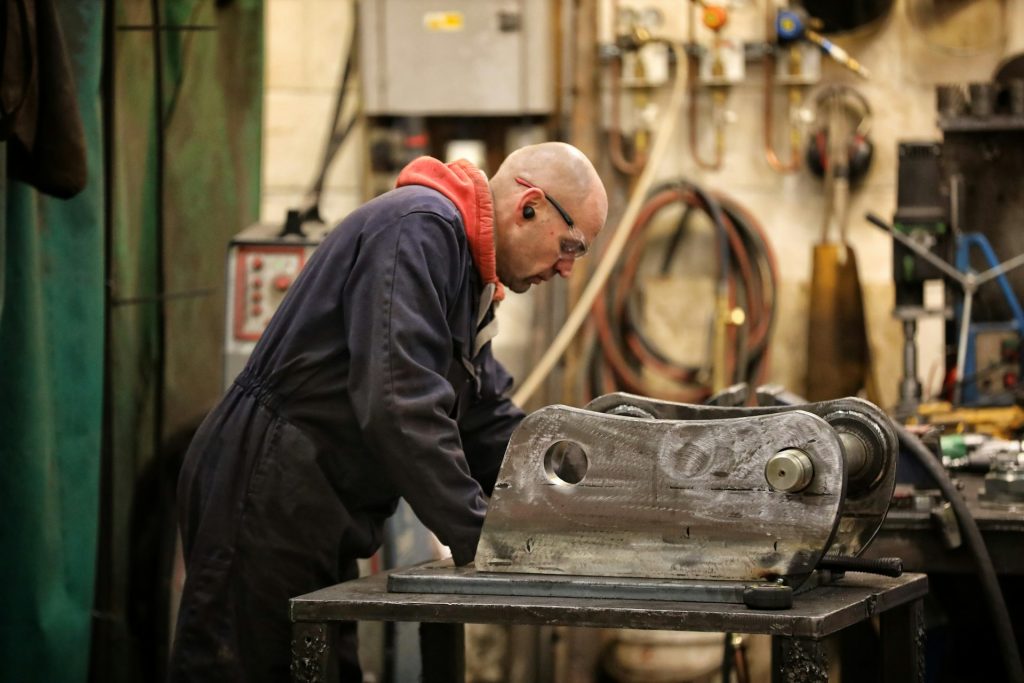
Machinist checking a heavy cast part at the bench before repair
Gray cast iron is brittle and carries a lot of carbon, so the heat of welding tends to crack it right beside the repair. There are two reliable approaches. The hot method preheats the whole part, often to 500°F or more, welds with nickel-iron filler like ERNiFe-CI, and cools it slowly under insulation. The cold method keeps the part near room temperature and lays short stitch welds about an inch long, peening each one and letting it cool before the next.
For many non-structural parts, braze welding is the better call. TIG brazing with silicon bronze filler, ERCuSi-A, joins cast iron at a much lower temperature without melting the base metal, so it rarely cracks. It won't match the color, and it isn't right for parts that run hot. Machine bases, old pump bodies, antique equipment and manifold flanges are typical candidates.
When a weld itself let go, the fracture face tells the story. Shiny, unfused metal along one side means lack of fusion: the weld sat on top of the base metal instead of melting into it. A crack down the center of the bead points to the wrong filler or a concave bead. Porosity says contamination or poor gas coverage. Rust bleeding from a stainless weld says carbon steel tools or a missing purge.
The repair is to cut the old weld out completely, back to clean base metal, re-prep the joint, and weld it properly. Welding over a bad weld just buries the defect. We check the finished repair visually and with dye penetrant, and leak or pressure test tanks and housings before they go back. Repairs to boilers and code-stamped pressure vessels generally go through a National Board R-stamp holder; if your part falls in that category, we will tell you up front.
Have a drawing or a photo of the part?
Text it to us or send it through the quote form. We reply with questions or a written quote.
Parts that can be removed come out better in the shop, where we can preheat evenly, position the weld and clean up properly. Installed equipment can often be repaired where it sits; our mobile TIG welding service covers that. For a general sense of what repair work tends to cost in the market, our post on TIG welding cost in Texas breaks down the factors.
Restoration work is slower than repair and priced that way. Rebuilding a worn shaft shoulder, filling a wallowed-out bolt hole before re-drilling, or straightening and re-welding an old trailer frame takes layout, buildup passes and often machining after. It is still usually cheaper than a custom replacement part with a long lead time.
A good photo set saves a lot of back and forth. Take one wide shot showing the whole part, and close-ups of each end of the crack with a coin or ruler for scale. Then send them with the notes below through our contact page.
What the part is, its make and model or part number
Metal, if known, or where the part came from
How it failed: sudden break, slow crack, leak
What it does: pressure, load, heat, vibration, food contact
Whether it can be removed and shipped or brought in
Any earlier repairs, and how long they lasted
Can cast iron be welded or does it have to be brazed?
Cast iron can be welded, but it needs care. The usual methods are hot welding with full preheat and nickel filler, or cold welding with short stitch beads and peening. Braze welding with silicon bronze is often easier and less likely to crack, because the cast iron never melts. Brazing suits non-structural parts that don't run hot. The part and its service decide which is best.
Why did my aluminum weld crack?
Common causes are fusing 6061 without filler, using the wrong filler for the alloy, leaving an unfilled crater at the end of the weld, welding over a crack that was never ground out, or putting a weld in a high-stress spot. Vibration and fatigue then finish the job. A good repair removes the crack fully and addresses whatever caused it, not just the visible line.
Can you weld a cracked aluminum transmission or engine case?
Usually, yes. Engine and transmission cases are cast aluminum, often oil-soaked, so they need thorough degreasing and a bake-out before welding. We grind the crack out, check it with dye penetrant, preheat and weld with 4043 or similar filler. Machined surfaces and bores near the repair may need machining afterward. Thin die-cast parts can be harder to weld cleanly.
Is it worth repairing a cracked part or should I replace it?
Repair makes sense when the part is expensive, slow to get, obsolete or custom, and the crack has a clear, fixable cause. Replacement is the better call when the part is cheap and available, badly corroded, or cracking because it is undersized for the job. Pressure-stamped equipment may have code requirements for repair. A photo and a description usually tell us which way to go.
How do you stop a crack from spreading before welding?
Drill a small hole, usually 1/8 to 1/4 in., just beyond each visible end of the crack. The round hole spreads the stress at the crack tip so the crack stops running. Dye penetrant shows exactly where the crack ends, since it often extends past what you can see. Then the crack is ground out between the holes and welded.
Can you repair a leaking stainless tank?
In most cases, yes. Leaks in stainless tanks usually come from cracked welds at nozzles, legs or seams, pitting from chlorides, or old welds with lack of fusion. We find the leak, grind out the defect, weld with matching filler and purge where we can reach the back side. Then the area is cleaned and passivated if it is product contact, and leak tested.
Aluminum
AC TIG welding for 5xxx and 6xxx aluminum: boats, trailers, tanks, brackets and castings, with filler picked for strength, color and service.
See the service →
Mobile welding
On-site TIG welding for plant shutdowns, installed equipment and repairs that can't come to the shop. Statewide travel, quoted by distance.
See the service →
Stainless steel
304 and 316L stainless TIG welded with full back purge, controlled heat tint and clean, passivated finishes for food, pharma and architecture.
See the service →
Get a quote
Send drawings, photos or a short description. We reply with questions or a written quote.
Request a quote