
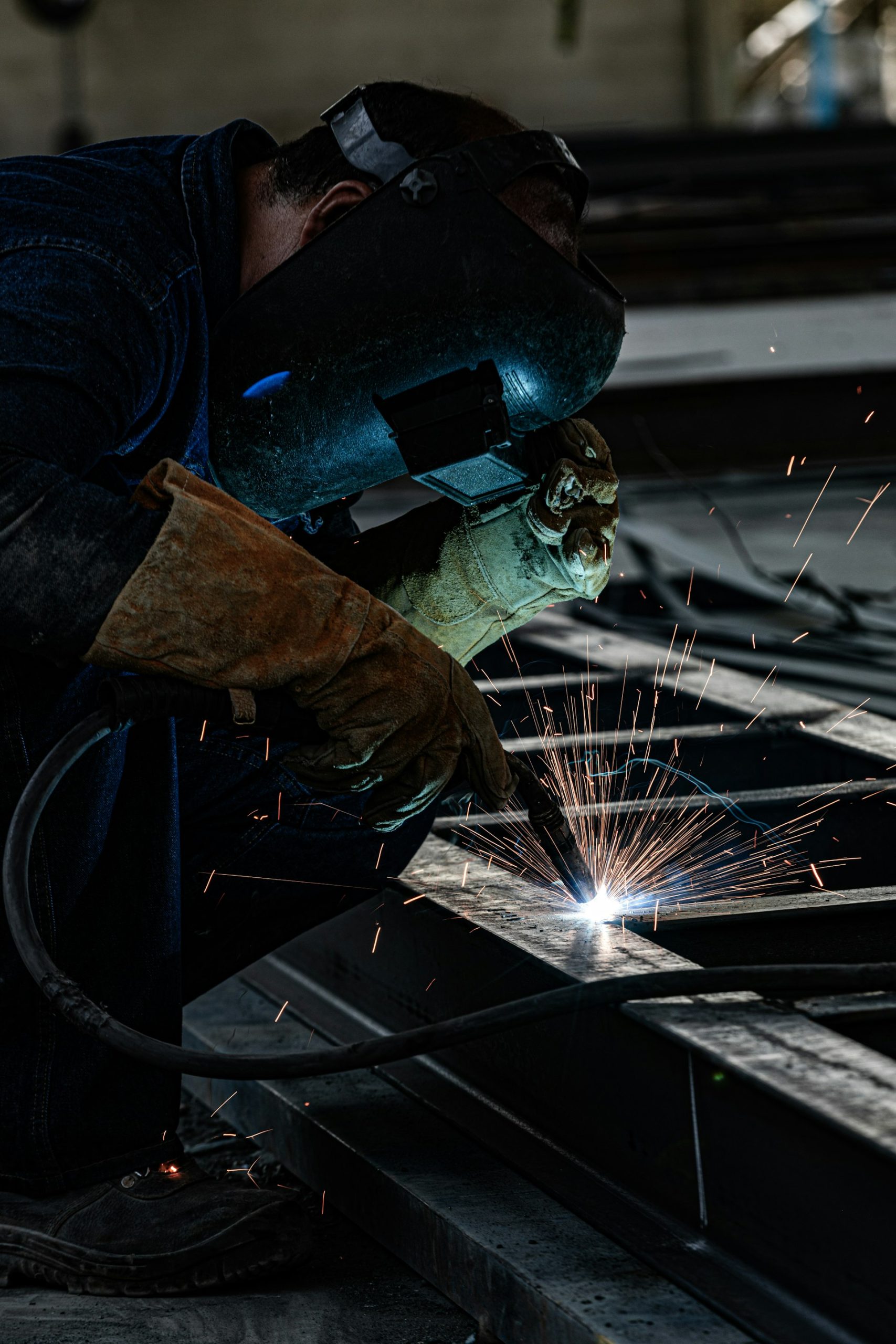
Short answer: Choose TIG welding when the weld has to be clean and tightly controlled: thin stainless, aluminum, sanitary tube, pipe roots, chromoly and visible welds. Choose MIG when you need speed on thicker carbon steel and the weld will be hidden or painted. By hand, TIG puts down roughly 1 to 2 pounds of filler an hour while MIG runs several times faster, so MIG usually costs less per foot of weld.
TIG and MIG are both gas-shielded arc welding processes, and both can make sound, code-quality welds. The difference is how the filler gets into the joint and how much control the welder has over the puddle. That one difference drives almost everything else: speed, cost, which metals each one handles well, and what the finished bead looks like.
Most of what we do is TIG, so read some bias into this article. We still tell customers to use MIG when it fits the job better, and there are plenty of jobs where it does.
What TIG welding is
TIG welding (tungsten inert gas), formally gas tungsten arc welding (GTAW), strikes an arc between a non-consumable tungsten electrode and the work. The tungsten does not melt into the weld. The welder feeds filler rod by hand with the other hand, or skips filler entirely on thin edge joints and some tube butts. A weld with no filler is called autogenous. Heat comes from a foot pedal or a fingertip control, so amperage can change mid-bead as the part heats up.
Shielding gas is almost always pure argon, usually 15 to 25 cubic feet per hour through the torch. Argon-helium mixes come out for thick aluminum and copper, where you need more heat than argon alone gives. Carbon steel and stainless are welded on DC electrode negative. Aluminum and magnesium are welded on AC, because the electrode-positive half of each cycle breaks up the oxide skin on the surface.
What a TIG setup looks like at the bench
A typical stainless setup in our shop: 3/32 inch 2% lanthanated tungsten ground to a point with the grind marks running lengthwise, a #8 gas lens cup, and 1/16 or 3/32 inch ER308L or ER316L rod. On sanitary tube or a pipe root, the inside gets an argon purge as well. None of that is exotic. It is slow work with both hands and one foot busy at the same time, and the welder has to keep the tungsten out of the puddle. Dip it once and you stop, break off the contaminated tip and regrind.
What MIG welding is
MIG welding (metal inert gas), formally gas metal arc welding (GMAW), feeds a solid wire electrode continuously through the gun. The wire is the electrode and the filler at once. Pull the trigger and the machine feeds wire at a set speed while the power source holds a set voltage. The welder steers the gun and manages travel speed and angle. MIG runs on DC electrode positive.
Gas depends on the metal. Carbon steel usually runs on 75% argon and 25% CO2, which most people call C25, for short-circuit transfer, or a 90/10 mix for spray. Stainless MIG uses argon with a small percentage of CO2 or oxygen, or a helium-based tri-mix. Aluminum MIG uses straight argon and a spool gun or push-pull gun, because soft aluminum wire bird-nests when you try to push it through a long liner.
Transfer modes matter
MIG has several metal transfer modes. Short-circuit transfer runs cool and works well on thin steel and out of position, but it is prone to cold lap and lack of fusion on thick sections. That is why AWS D1.1, the structural steel code, does not treat short-circuit GMAW as prequalified. A shop has to qualify it by testing first. Spray and pulsed spray transfer run hotter and dig deeper, and they are what make MIG so fast on plate.
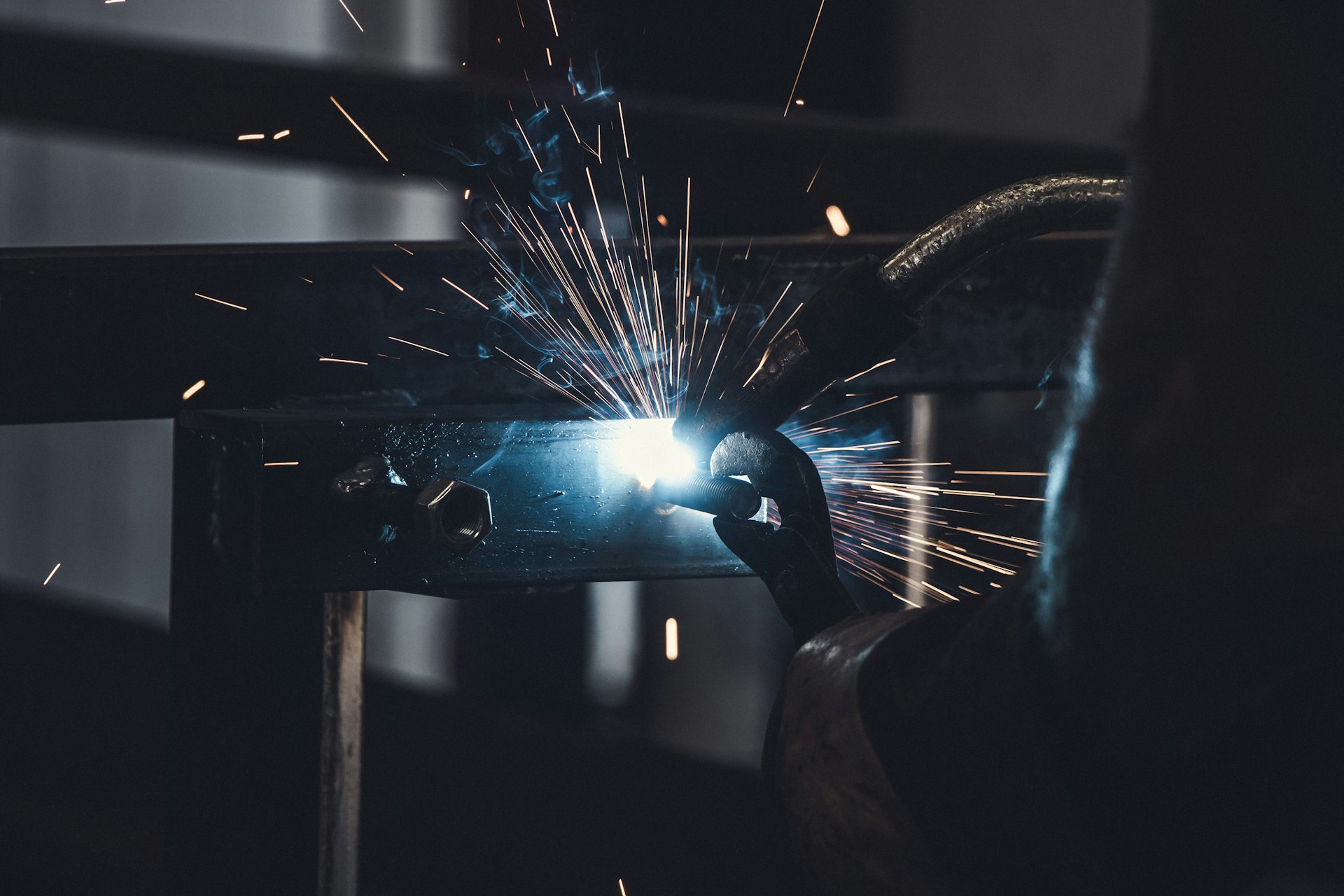
TIG vs MIG side by side
The table compares the two processes the way a fabrication buyer usually weighs them. Numbers are typical for manual welding and shift with wire size, joint design and the person holding the torch.
| Factor | TIG (GTAW) | MIG (GMAW) |
|---|---|---|
| Electrode | Non-consumable tungsten | Consumable wire that is also the filler |
| Filler | Hand-fed rod, or none (autogenous) | Continuously fed wire |
| Typical manual deposition | About 1 to 2 lb per hour | About 4 to 10 lb per hour |
| Thinnest practical material | Around 0.020 in, thinner on tube edges | Around 22 to 24 gauge steel, with care |
| Heat control | Adjustable during the weld with a pedal | Set before the weld starts |
| Spatter | None | Some, most with short-circuit on CO2 mixes |
| Aluminum | AC TIG, best on thin and cosmetic work | Spray or pulse with a spool or push-pull gun, fast on thick work |
| Fit-up tolerance | Needs tight, clean fit-up | Bridges small gaps more easily |
| Typical polarity | DCEN for steel, AC for aluminum | DCEP |
| Learning curve | Long | Shorter |
| Cost per foot of weld | Higher | Lower |
Read it as a list of tradeoffs, not a scoreboard. Nearly every line where MIG wins is about speed. Nearly every line where TIG wins is about control.
When TIG is the right call
We point people toward TIG when the weld itself is the hard part of the job, rather than the volume of weld metal.
- Thin material. Sheet under about 1/8 inch, thin-wall tube, and anything that warps if you look at it wrong. Pedal control lets the welder back off heat as the part soaks it up.
- Stainless where corrosion resistance matters. Food, beverage, pharma and chemical equipment. Low heat input and a proper back purge keep chromium in solution where it belongs. Our guide to back purging stainless steel covers that part in detail.
- Aluminum parts that have to look right or hold pressure. Boat fittings, fuel cells, intercooler piping, thin tanks.
- Pipe and tube root passes. A TIG root on a purged joint leaves a smooth, fully fused inside surface. On many pipe jobs the root and hot pass go in with TIG and the fill and cap go in with stick or wire.
- Chromoly, titanium and other demanding alloys. 4130 race car tube, titanium, nickel alloys, copper and brass all default to TIG.
- Visible welds. Railings, architectural stainless, furniture, motorsports. There is no spatter to grind off, and the bead can be left as welded.
Codes point the same way. Aerospace fusion welding under AWS D17.1, sanitary tube work to 3-A and ASME BPE, and a lot of process piping under ASME B31.3 are built around GTAW, at least for the root. When a job calls for one of those, tell us which code applies and we plan the procedure around it.
When MIG is the better tool
MIG wins when there is a lot of weld to put down and nobody is going to look at the bead with a magnifier. Structural carbon steel, trailer frames, heavy brackets, equipment skids, and fillet welds on 1/4 inch and thicker plate all land in that bucket. Spray transfer on 3/8 inch plate finishes a joint in a fraction of the time it takes to TIG the same fillet, and the weld is every bit as strong if the procedure is right.
MIG is also easier to keep consistent across a crew, which is why production shops are built around it. If you are buying 200 identical mild steel brackets that will be powder coated, paying for TIG on every one of them rarely makes sense.
Where MIG struggles
MIG has weak spots. Short-circuit MIG on thick steel can lay a bead that looks fine on top and never fused into the sidewall. Thin aluminum burns through fast because you cannot dial heat down mid-weld. Outside, a light breeze strips the gas shield and you get porosity. And MIG on stainless leaves spatter and heavier heat tint, which need cleanup before the part goes anywhere near a food plant.
Strength, quality and appearance
A lot of people believe TIG welds are stronger. That is only half true. Strength comes from the filler metal, full fusion and sound weld metal. A properly made MIG weld with ER70S-6 wire on A36 steel meets the same 70 ksi minimum tensile strength as a TIG weld made with ER70S-2 rod. Both fillers are classified under AWS A5.18, and the classification sets the strength, not the process.
Where TIG pulls ahead is the defect rate on difficult joints. The welder sees the puddle clearly, there is no spatter, and heat can be adjusted on the fly, so lack of fusion, porosity and undercut are easier to avoid on thin or awkward parts. On a 3/8 inch fillet in the flat position, a good MIG welder and a good TIG welder will both make a sound weld. On 18 gauge 304 stainless outside corners, it is not close.
On looks: a TIG bead on stainless should come off the torch light straw to gold, with even ripples. Blue or gray means too much heat, too little gas, or both. MIG beads are wider and flatter. A good one looks clean, but it rarely looks like a row of stacked dimes.
Cost per foot vs cost per job
TIG costs more per foot of weld, and most of that is labor. The welder puts down less metal per hour, fit-up has to be tighter, and parts often need more cleaning before the arc ever starts. Argon and tungsten are not the expensive part. Time is.
The cheaper process per foot is not always the cheaper job, though. A TIG weld on a cosmetic stainless part might need a light brush and passivation. The MIG version of the same part might need grinding, blending and polishing to get rid of spatter and wide discoloration, and that labor can wipe out the savings. For a broader look at what moves welding prices here, see our article on TIG welding cost in Texas.
Using both on one job
Plenty of jobs use both. A carbon steel pipe spool may get a TIG root and MIG or flux-cored fill. A frame might be MIG welded everywhere except a few visible joints that get TIG. Nothing says a job has to pick one process, as long as each one is covered by whatever procedure the job requires.
How to decide for your project
Start with the metal and the thickness, then the code, then the volume. Here is the short checklist we walk through with customers:
- What is the base metal and alloy? Stainless, aluminum, chromoly and titanium lean TIG.
- How thick is it? Under 1/8 inch leans TIG. Carbon steel over 1/4 inch leans MIG.
- Does a code or spec name the process? Sanitary, aerospace and many piping specs do.
- Will the weld be seen, polished or left as welded?
- Does the inside of the joint matter? If it does, you need a purge, and that usually means TIG.
- How many feet of weld, and how many parts?
- Can the part come to a shop, or does the welding happen in place?
If most of your answers point toward thin, clean or code-driven work, look at our stainless steel TIG welding and aluminum TIG welding services. If you are still on the fence, send a drawing or a few photos through the quote page with the material and quantity, and we will tell you which process fits. Sometimes the answer is MIG, and we will say so.
Frequently asked questions
Not by itself. Weld strength comes from the filler metal classification and full fusion, not the process name. ER70S-6 MIG wire and ER70S-2 TIG rod both carry a 70 ksi minimum tensile rating under AWS A5.18. TIG tends to produce fewer defects on thin or awkward joints because the welder controls heat during the weld, which is why it is preferred where failure is expensive.
Yes. Stainless MIG uses ER308L or ER316L wire with an argon-rich gas, such as argon with 2% CO2 or a helium tri-mix. It works well on thicker stainless where speed matters. For thin sheet, sanitary tube, or joints where the inside surface must stay corrosion resistant, TIG with a back purge is the usual choice because heat input is lower and there is no spatter to clean.
TIG is better for thin aluminum, cosmetic welds, castings and anything that must hold pressure, because AC TIG cleans the oxide and lets the welder control heat. MIG with a spool gun or push-pull gun is faster on aluminum 3/16 inch and thicker, such as trailer frames and heavy brackets. Both use 4043 or 5356 filler depending on the alloy.
Mostly labor. TIG deposits about 1 to 2 pounds of filler per hour by hand, compared with several times that for MIG, and it needs tighter fit-up and cleaner parts. Gas and consumables are a small part of the bill. On cosmetic or stainless work, TIG can still come out cheaper overall because it needs less grinding and polishing afterward.
MIG is easier to learn. The machine feeds wire and holds voltage, so a new welder mainly manages gun angle and travel speed. TIG uses both hands and a foot pedal at once, and the tungsten has to stay out of the puddle. Most welders can run a passable MIG bead in days, while consistent TIG work on stainless or aluminum takes much longer to develop.